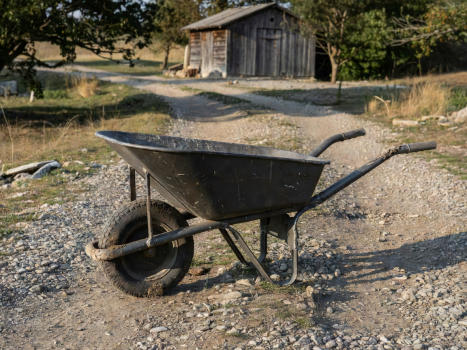
Transporting with Efficiency
The movement of bulk materials—soil, compost, gravel, and heavy root balls—constitutes a massive portion of the physical labor in gardening. Selecting a poorly designed transport tool leads to tipping, muscle strain, and damaged pathways. Understanding the physics and materials of wheelbarrows and carts is essential for a safe and efficient garden.
Tray Materials and Capacities
The "tray" or "tub" of the wheelbarrow holds the load. Its material dictates what you can comfortably transport.
- Galvanized Steel: The traditional choice. Steel is incredibly strong and resistant to cracking under the impact of heavy rocks or dropped logs. However, it is heavy and will eventually rust if the galvanized coating is scratched and left exposed to moisture.
- High-Density Polyethylene (HDPE) Plastic: Modern plastic trays are entirely rust-proof, significantly lighter than steel, and resistant to chemical corrosion from fertilizers and manure. While high-quality HDPE is highly resilient, extreme cold can make cheap plastic brittle and prone to cracking under impact.
Capacity is usually measured in liters or cubic feet. A standard garden wheelbarrow holds between 85 to 100 liters (around 3 to 4 cubic feet). Heavy-duty builders' barrows can exceed 120 liters. Remember that a larger capacity is only useful if you possess the physical strength to lift and balance it when fully loaded with dense, wet soil.
Wheel Configurations: Single vs. Double
The number of wheels drastically alters the dynamics of the tool.
Single-Wheel Barrows: These offer unmatched maneuverability. The single pivot point allows the user to tilt the barrow to dump material precisely or navigate highly uneven, narrow terrain, like a plank laid across a trench. The severe drawback is lateral instability; the user must provide all the lateral balance, which requires significant core and arm strength, particularly on slopes.
Double-Wheel Barrows (and Carts): By placing two wheels on an axle, lateral balance is inherently solved. These are vastly easier to push on level ground and eliminate the wrist strain associated with balancing a heavy, shifting load. The trade-off is reduced maneuverability in tight corners and difficulty navigating narrow, rutted paths where one wheel might drop into a depression.
Tire Technologies
The interface between your load and the ground determines how much effort you must exert.
Pneumatic Tires: These air-filled tires provide a built-in suspension system. They absorb the shock of bumps, roots, and rocks, preventing the barrow from bouncing out of your hands. They also offer a wider footprint, which prevents sinking into soft mud. Their obvious flaw is susceptibility to punctures from thorns or nails, necessitating occasional patching or tube replacement.
Solid and Semi-Solid Tires: Often made of solid polyurethane foam, these "flat-free" tires completely eliminate the risk of punctures and the need to monitor tire pressure. Modern foam tires closely mimic the bounce and give of pneumatic tires, making them the superior choice for most gardeners, despite a slightly higher initial cost.