The Science of Hydration
Effective watering is not merely about volume; it is about delivery. Providing water at the correct rate ensures deep soil penetration, encouraging deep root systems. Surface-level splashing promotes shallow roots that are highly susceptible to drought. The right equipment gives you precise control over this delivery.
Watering Cans: Form and Function
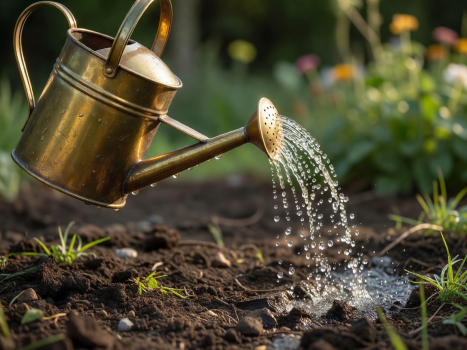
A watering can is essential for targeted hydration, container gardening, and applying liquid fertilizers.
- Material Choices: High-grade plastic cans are lightweight and durable, making them easy to carry when filled (a 10-liter can weighs over 10kg). Traditional galvanized metal or copper cans are heavier and more expensive but offer unparalleled longevity and rust resistance. Copper also possesses natural anti-microbial properties that can help prevent waterborne fungal spores.
- The Rose: The perforated cap on the spout is called a rose. An oval-shaped brass rose facing upward delivers a fine, gentle rain ideal for delicate seedlings and prevents soil displacement. Facing the rose downward provides a heavier, faster flow for established shrubs and trees. Ensure the rose is removable for easy cleaning of mineral deposits.
- Balance: A well-designed can features a wrap-around tubular handle. This allows you to shift your grip as the water level drops, maintaining perfect balance and reducing strain on the wrist.
Garden Hoses and Anti-Kink Technology
For larger gardens, a hose is indispensable. The frustration of a kinked hose cutting off water pressure is well known, leading to the development of multi-layered hose technologies.
Standard PVC hoses are cheap but prone to kinking, UV degradation, and becoming rigid in cold weather. Premium rubber or reinforced polyurethane hoses utilize internal woven mesh (often polyester) to resist kinking and burst pressure. While heavier, these materials remain flexible across a wide temperature range and coil neatly on a reel.
Expandable hoses, which shrink to a fraction of their length when empty, offer incredible convenience and light weight. However, they are highly vulnerable to punctures from thorns and sharp stones, and their internal latex bladders have a shorter lifespan than solid rubber alternatives.
Drip Irrigation: The Gold Standard for Efficiency
If you are watering extensive vegetable beds or complex perennial borders, surface watering with a hose is inefficient. Up to 30% of water applied by overhead sprinklers is lost to evaporation or runoff before it reaches the root zone.
Drip irrigation systems solve this by utilizing a network of narrow-gauge pipes with integrated emitters. These emitters slowly release water directly onto the soil surface above the root ball at a rate of 2 to 4 liters per hour. This slow seep allows capillary action within the soil to draw moisture deeply downwards.
Setting up a drip system involves a pressure regulator (to prevent the emitters from blowing out), a micron filter (to prevent clogs), the mainline tubing, and the individual drippers or porous soaker hoses. When paired with a programmable timer attached to the tap, a drip system provides highly consistent, localized watering that saves both time and significant volumes of water.