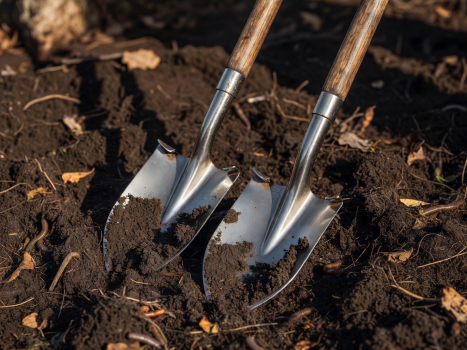
Distinguishing Spades from Shovels
While often used interchangeably by beginners, spades and shovels perform distinctly different tasks in the garden. A spade generally features a flat, rectangular blade with a straight edge, designed primarily for slicing through soil, edging lawns, and digging straight-sided trenches. A shovel features a scooped blade, often with a rounded or pointed tip, engineered for lifting and moving loose material like gravel, sand, or excavated dirt.
Key Types of Spades
Selecting the right spade is a matter of matching the tool's dimensions to both the task at hand and the physical stature of the user.
The Digging Spade
The standard digging spade is the workhorse of the garden. It typically features a large blade, around 11 to 12 inches long and 7 to 8 inches wide. It is ideal for breaking new ground, double-digging beds, and moving significant volumes of earth. Because of its size, a fully loaded digging spade can be heavy, requiring a sturdy user and proper lifting technique to avoid back strain.
The Border Spade
A smaller sibling to the digging spade, the border spade is lighter and narrower, usually with a blade measuring around 9 inches by 5.5 inches. Its compact size makes it perfect for working in confined spaces, maneuvering between established plants in perennial borders, or for gardeners who prefer lifting lighter loads to reduce fatigue.
Shaft Materials: Tradition vs. Technology
The shaft (or handle) material dictates the tool's weight, flexibility, and longevity. The market provides three main options:
- Wood (Ash or Hickory): Traditional and highly favored for its natural ability to absorb shock. A good ash shaft will flex slightly under pressure, reducing the jar on your shoulders and wrists. However, wood requires maintenance; it must be kept dry and occasionally oiled to prevent splitting and rot.
- Fiberglass: Exceptionally durable and weather-resistant. Fiberglass shafts are lighter than solid wood and will not rust or rot. They are excellent for heavy-duty tasks where a wooden shaft might snap under leverage, though they lack the natural shock absorption of wood.
- Tubular Steel: Often the strongest option available, solid steel shafts are virtually unbreakable under normal gardening conditions. The trade-off is weight and vibration; steel is heavy and transfers every rock strike directly up the shaft to the user's hands.
Handle Grips: T-Grip vs. D-Grip
The top grip of a spade determines how you apply downward force and control the load when lifting.
The T-Grip is a traditional European design, simply forming a 'T' at the top of the shaft. It allows for a relaxed hand position and is excellent for driving the blade straight down. The D-Grip (or YD-Grip) forms an enclosed loop. This provides a more secure hold, especially when wearing thick gloves, and offers better leverage when twisting the spade to break up a clod of earth or lift a heavy load.
Blade Construction Features
Look for tools featuring a "tread"—a folded or welded top edge on the blade. Treads provide a wider platform for your boot, allowing you to apply maximum downward pressure without the thin metal edge cutting into the soles of your footwear.
Additionally, consider the connection between the blade and the shaft. A socket connection, where the metal wraps completely around the wooden shaft and is secured with rivets, is far stronger than a simple strap or tang connection.